Showing posts with label Appalachia. Show all posts

Saturday, November 2, 2013

Autumnal photos from the NC mountains


We moved from Blacksburg to Black Mountain this summer, and slowly discovered that relocation takes an amazing amount of time. Between packing, moving, unpacking, and settling in, it seems like the summer and fall flew by. While I took a lot of photos I haven't posted that many. Yet. Here's a bunch of photos from various places in our extended NC mountain neighborhood.
View east from the Craggy Gardens parking lot on the BRP.


Barrie and Cindy hiking.

Barrie on the Blue Ridge Parkway

Buddha on the potting bench

Ray of sunshine backlighting a leaf on the trail near our house.

Flat Creek in Montreat. Our "quick n' easy" nearby hiking trail.

Pond across the highway from our little neighborhood

Asta hanging out on the floor in my study.

On the roof of our rental house. The meditation room is on the right.

Our living room. The house was constructed using the windows and flooring from an old church. 
View of the UNCA quad from the library's front steps. Mt. Pisgah is in the background.

Window in my study.
Catawba Falls.

Illuminated Edwin on the Catawba Falls trail

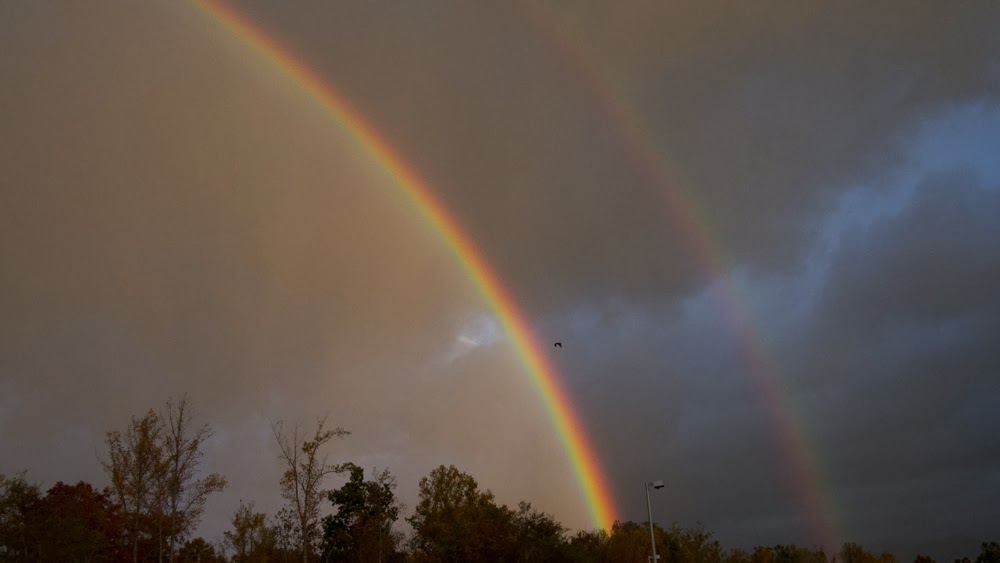
Double rainbow

Tuesday, April 7, 2009

Appalachian native wins second NCAA national championship

Appalachian native Roy Williams, head coach of the North Carolina Tar Heels, led his team to the NCAA Men's Basketball National Championship last night. The Tar Heels defeated Michigan State 89-72 to win North Carolina's second national championship under Williams, who also won in 2005. It was North Carolina's fifth NCAA men's basketball championship overall.

Williams spent his early years in the Appalachian towns of Marion and Spruce Pine, NC, but as a young child his family moved to Biltmore, outside of Asheville, NC. Williams was raised near the famous Biltmore Estate, the megamansion built by robber baron George Vanderbilt in the nineteenth century. Williams attended T. C. Roberson High School, where he earned letters in basketball and baseball.

A 2003 article by Ed Hardin, in the Greensboro, NC, News & Record, discussed Williams' years in Biltmore :

"I've never even been inside it," Williams said (of the Biltmore House)...He lived on another hill in a tiny white house under two giant hardwoods.

Williams escaped from these hills in a Ford Mustang, and he fully intended to come home forever. His mother died in 1992 and his alcoholic father moved a few years back... "My mother was my hero," he said. "She was a very intelligent, uneducated lady who only went through the 10th grade. She always said, 'You just try to do the right thing, and sometimes the right thing is not necessarily what you want to do, but you do the right thing.' "

"When I was a youngster I dreamed of playing at North Carolina," he said. "Then I dreamed of coaching at North Carolina. You may not believe this, but I never dreamed of being a head coach at North Carolina. I always dreamed of being coach Smith's assistant."

T.C. Roberson High School sits far off the main road, located on the banks of Lake Julian just below the Blue Ridge Parkway. The gym is named for Buddy Baldwin, the Roberson basketball coach who would become Williams' mentor.

Baldwin said that was something he found out later.

"You don't know about things like that at the time," he said. "I knew Roy when he came in the ninth grade. He played basketball, and he played baseball. He was a little guy, but he loved the game, and he worked really, really hard at it."

Basketball would be his way out, and he determined that early on.

"Roy could've done anything he wanted," Baldwin said. "And I mean anything. He was a very good student - a Morehead scholarship nominee. He had an offer to go to Georgia Tech on an engineering scholarship, but he wanted to be a coach."

Williams went to UNC where he met Smith and soon became a student of Smith's game. Williams was allowed to watch UNC practices. Upon graduation, Williams headed back to the mountains to start his career.

"You look at his teams now, you can see his teams at Owen," Baldwin said. "They had very little talent when he first started, but they developed quickly. They played very hard, and he played a lot of what Carolina did - run-and-jump, man-to-man defense. He played a lot of kids, not just the six or seven best. He played all of them, alternating them in and out. He took what he'd learned and did what he could with it."

Williams learned he wanted to coach forever. He learned he wanted to coach like Buddy Baldwin and Dean Smith. And as much as it hurt him, he learned he'd have to get out of western North Carolina to do it.

"If I have something I like, I usually stick with it," he said last week. "It's hard for me to leave and do something else. I've had the same putter for 34 years, and the same wife for 29."

Change comes slow to the mountains. The appeal of small towns like Biltmore and even the larger mountain towns such as Asheville is the slow evolution over time.

While Biltmore looks the same to the occasional tourist, the locals believe it's changed dramatically.

"It's been like an explosion," Baldwin said.

Williams would recognize his old neighborhood. Not much has changed since the day he left. The explosion of upscale homes and coffee shops and eclectic restaurants happened elsewhere. He likely wouldn't have much time for them.

His memories of home are of his mother and of the basketball courts at Biltmore Elementary, where he learned the game of basketball and discovered a way out. The irony on the hill, the giant Biltmore Estate that turned away locals while turning a profit on the tourists, was never a part of his world.

"I used to sneak onto the grounds," Williams recalled a few years back. "We'd steal sugar cane poles for the pole vaulters in high school. But I never went in."

There's an expanse between the haves and have-nots here, and it forms a person from an early age. There are million-dollar homes just off Hendersonville Road, and there are places like 6 Warren Ave.

Of course, that's the history of this place. Asheville looks just as it did decades ago when much of the state and the nation was blowing up old buildings to make way for new ones. Asheville couldn't afford to do it, so there's an old charm that can never be reproduced or bought.

Thomas Wolfe said the mountains beckon you to leave and then call you back home. People who leave here do come back again, and most haven't changed a bit. Williams doesn't come back as much as he used to, but he does from time to time. And when he does, he calls Baldwin, his old basketball coach, and they go play golf.

"Roy's the same now as he was way back then," Baldwin said.

Sources: News & Record, Greensboro, NC, April 20, 2003./ Photos from ESPN.com

Wednesday, September 17, 2008

Field Trip: Coal wars, mountaintop removal

The mountains are going away, not too far from where I live. Driving down Interstate 77 through West Virginia appears largely idyllic as you pass through rolling, green mountains. But just a mile or so away the hills and valleys are merging into a flat, lifeless, poisoned wasteland.

This wanton destruction of Appalachia is called mountaintop removal (MTR). If there's any evidence that Mordor lurks outside of the fictional realm of Middle Earth, surely it resembles the scars and devastation wreaked by MTR. Sauronesque analogies to the people who run Massey Energy and other coal companies may seem a stretch, but not much of one.

Last month I joined a few dozen colleagues in a fact-finding trip to the West Virginia coal fields as part of the Surface Mining Study at Radford University. Before visiting an MTR site, we first explored the history of the West Virginia Mine Wars, where coal company owners and hired detectives fought pitched battles with miners who were trying to organize unions. One of the most gripping sites was this concrete pillbox, situated on an outcropping overlooking Cabin Creek, where the coal companies and their hired thugs could train machine guns and rifles on the miners in the valley:

The West Virginia Division of Culture and History provides a succinct summary of events:
In 1902, the UMWA finally achieved some recognition in the Kanawha-New River Coalfield, its first success in West Virginia. Following the union successes, coal operators had formed the Kanawha County Coal Operators Association in 1903, the first such organization in the state. It hired private detectives from the Baldwin-Felts Detective Agency in Bluefield as mine guards to harass union organizers. Due to these threats, the UMWA discouraged organizers from working in southern West Virginia.

By 1912, the union had lost control of much of the Kanawha- New River Coalfield. That year, UMWA miners on Paint Creek in Kanawha County demanded wages equal to those of other area mines. The operators rejected the wage increase and miners walked off the job on April 18, beginning one of the most violent strikes in the nation's history. Miners along nearby Cabin Creek, having previously lost their union, joined the Paint Creek strikers and demanded:

  • the right to organize
  • recognition of their constitutional rights to free speech and assembly
  • an end to blacklisting union organizers
  • alternatives to company stores
  • an end to the practice of using mine guards
  • prohibition of cribbing
  • installation of scales at all mines for accurately weighing coal
  • unions be allowed to hire their own checkweighmen to make sure the companies' checkweighmen were not cheating the miners.

When the strike began, operators brought in mine guards from the Baldwin-Felts Detective Agency to evict miners and their families from company houses. The evicted miners set up tent colonies and lived in other makeshift housing. The mine guards' primary responsibility was to break the strike by making the lives of the miners as uncomfortable as possible.

As the intimidation by mine guards increased, national labor leaders, including Mary Harris "Mother" Jones, began arriving on the scene. Jones, a native of Ireland, was already a major force in the American labor movement before first coming to West Virginia during the 1897 strikes. Although she reported the year of her birth as 1830, recent research indicates she was probably born in 1845. As a leader of the UMWA's efforts to organize the state, Jones became known for her fiery (and often obscene) verbal attacks on coal operators and politicians.

Not only did the UMWA send speechmakers, it also contributed large amounts of weapons and ammunition. On September 2, Governor William E. Glasscock imposed martial law, dispatching 1,200 state militia to disarm both the miners and mine guards. Over the course of the strike, Glasscock sent in troops on three different occasions.

After this historical background, our next stop was Kayford Mountain, where Larry Gibson is defending his family's land against the destruction of Kayford Mountain, which is literally being blown away around his land. Gibson's courageous stand garnered him praise from CNN, who named him a "hero" for his efforts to educate and raise awareness about the devistation of MTR, particularly through the Keeper of the Mountain Foundation. Below are some photos from the trip, first of Larry talking with us, then of what's left of Kayford Mountain. Take note of the ridgeline behind Kayford - the mountains as far as you can see are slated for MTR.

Larry Gibson talking with us on his land, with the MTR of
Kayford Mountain actively going on behind him.

There's plenty of great information available about MTR. Here are a few good sources:

Monday, July 7, 2008

Brainfood #2: Ron Rash

Back to "Brainfood," snapshots of the words and music currently capturing my attention.

Ron Rash's novel The World Made Straight is a beautiful, moving Appalachian coming-of-age novel. It opens with this evocative paragraph:
Travis came upon the marijuana plants while fishing Caney Creek. It was a Saturday, the first week of August, and after helping his father sucker tobacco all morning he'd had the rest of the day to himself. He'd changed into his fishing clothes and driven three miles of dirt road to the French Broad River. Travis drove fast, the rod and reel clattering in the truck bed, red dust rising in his wake. The Marlin .22 slid on its makeshift gun rack with each hard curve. He had the windows down, and if the radio worked he would have had it blasting. The truck was a '66 Ford, battered from a dozen years of farm use. Travis had paid a neighbor five hundred dollars for it three months earlier.
Rash says so much in this paragraph, giving a succinct snapshot of an Appalachian farm boy. He's into fishing, has his .22 in the gun rack, he works on his father's farm, and is self-reliant enough to have bought his own truck. Yet Travis is much deeper than this snapshot - he wants far more from his life than you might surmise. Finding the dope leads him to Leonard, who on one level is a drug dealer hiding from his own past. As Leonard befriends Travis, he transforms himself from small-time dealer to Travis' mentor, bettering himself and the world around him in the process.

Each chapter opens with a passage from the diary of Leonard's Civil War-era ancestor, a doctor who practiced in the region and served as a medic in the war. Through this device the past creeps into the narrative, as the characters each discover that their ancestors played a part in the Civil War's infamous Shelton Laurel Massacre (Travis himself is a Shelton). The novel's characters eventually come to terms with their collective history, sorting out the legacy of the Civil War and the roles their ancestors played.

Rash paints a realistic, detailed portrait of contemporary Appalachia, where demons and redemption come from unexpected sources. A well-told tale that reveals much about how the past and present shape Appalachian life, with wonderfully wrought characters, The World Made Straight captivated me until the end. Highly recommended.